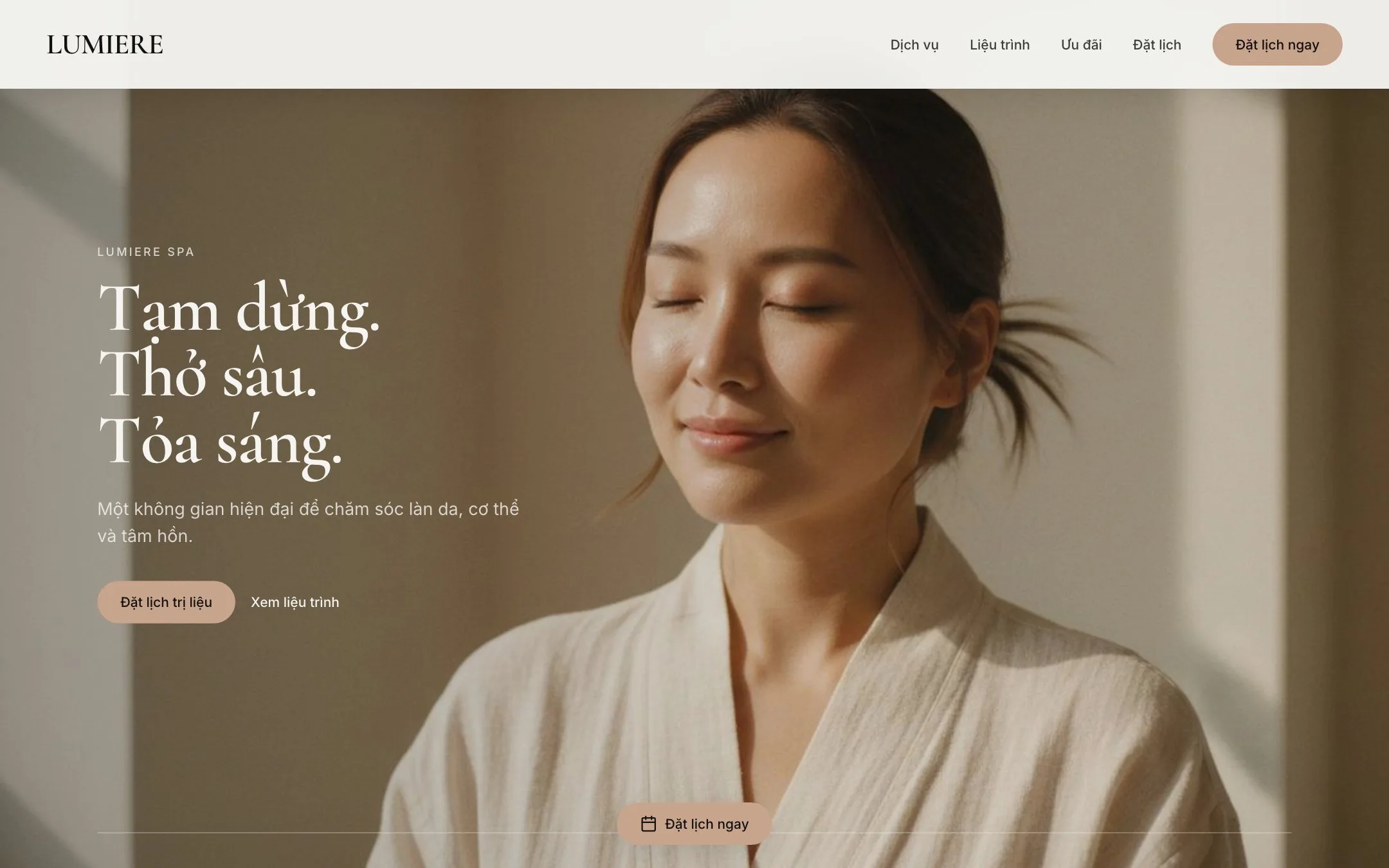
A sales landing page is a focused page built for one offer, one audience segment, and one conversion action. This English guide translates the core ideas from Skylabs' Vietnamese landing page strategy guide for teams that need clearer campaign pages.
When to use a landing page
Use a landing page when traffic comes from a specific campaign, ad group, email sequence, event, launch, or offer. A full website gives visitors many paths. A landing page reduces choice and keeps the visitor focused on the action that matters.
Good landing page use cases include:
- Booking consultations
- Selling one course or service package
- Testing a new offer
- Capturing leads from Google Ads or Meta Ads
- Promoting an event, opening, or limited campaign
The 12-part anatomy
A strong landing page usually includes these sections:
- Hero with clear offer and CTA.
- Short explanation of who the offer is for.
- Pain points that match the campaign promise.
- The solution and what is included.
- Benefits stated in customer language.
- Proof, case studies, testimonials, or credible signals.
- Process or what happens after submitting.
- Pricing or package information when useful.
- FAQ that removes common objections.
- Lead form with only necessary fields.
- Secondary contact path such as Zalo or phone.
- Final CTA that repeats the next step.
Message match
The page must match the ad or link that sent the visitor. If the ad promises a free consultation for spa website design, the hero, proof, FAQ, and CTA should all reinforce that same promise. Weak message match increases bounce rate and lowers lead quality.
Form design
Short forms usually perform better for cold traffic. Ask for the contact field first. Add optional fields only when they help the sales team qualify the lead. For Vietnamese campaigns, include Zalo and phone paths because many visitors prefer direct chat.
Mobile-first layout
Most ad traffic arrives on mobile. Buttons must be easy to tap, copy must wrap cleanly, images need stable dimensions, and the primary CTA should remain obvious without covering content. Avoid heavy animations that slow down the first screen.
Measurement
Track form submits, Zalo clicks, phone clicks, pricing views, scroll depth, and campaign source. Without event tracking, the team cannot tell whether the problem is traffic quality, offer clarity, page UX, or sales follow-up.
Common mistakes
The most common landing page mistakes are vague headlines, too many CTAs, long forms, weak proof, generic stock visuals, slow loading, missing mobile QA, no FAQ, no tracking, and copying the homepage instead of writing for the campaign.
Practical launch sequence
Start with one clear offer and one page. Launch, measure, then improve the headline, proof, form, and FAQ based on real objections. Scale only after the page converts reliably enough for the campaign economics to make sense.
Related services
Related articles
Ready to start?
Get a free consultation on website + landing page design for your business.